Showing posts with label Asia. Show all posts

Tuesday, November 12, 2019

The Tea Girl of Hummingbird Lane


The Tea Girl of Hummingbird Lane, by Lisa See

Amazingly, because I love books based in Asia, this was the first book I'd read by Lisa See. I'm not sure why it has taken me so long!

I enjoyed this family saga about a Chinese girl, Li-Yan, who was born into a very poor Akha tea family in the Yunnan Province. I'd never heard of the Akha or their strict traditions before, so I was
fascinated to read this story.

The story soon takes a dark twist, as Li-Yan's mother is a midwife, and Li-Yan witnesses a birth of twin babies. Because the Akha follow 100-year-old traditions extremely faithfully, her mother kills the babies (twins are bad luck) and exiles their parents. 

Clever, independent Li-Yan chafes against the misogynist, old-fashioned rules of her tribe, and when her own path takes a difficult turn, she leaves the village.


I won't say any more because I don't want to spoil the story, but I do want to say that Lisa See does an exceptional job tackling the complications of Chinese adoptions...and giving the reader a great appreciation for tea, especially the aged Pu-er tea.

I read this book for my book group, and I hosted the evening we discussed it. I ordered Chinese takeout and remembered I had intended to buy some Chinese tea for the occasion. On the off chance, I raided our tea cabinet, and what did I find? A box of Pu-er tea, which my husband had purchased on a whim. I was delighted at this lovely piece of synchronicity!

Read it, and drink some Pu-er tea! #NaBloPoMo2019

Wednesday, November 11, 2015

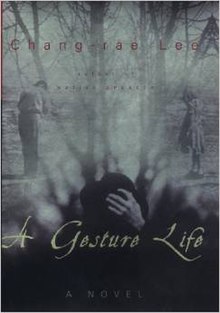
A Gesture Life

A Gesture Life, by Chang-Rae Lee

A Gesture Life is another book that was really hard to get into, but the patience paid off. If it hadn't been a book group selection, I might not have stuck with it.

Franklin Hata was a man who was difficult to admire or respect, because he seemed cold and heartless. His stilted relationship with his adopted daughter Sunny just made me sad. He had a chronic difficulty in relating to anyone on a deep, true level.

Presumably, this was because of his difficult experiences in the war and his obsession with K, a Korean "comfort woman." The storyline about the comfort women made me truly sick to my stomach. Apparently when Chang-Rae Lee began writing this novel, it was going to be all about comfort women, but he found that to be too heavy of a subject. His obsession with K reminded me of the foreign men I knew in Japan who were obsessed with Japanese women...many of them ended up marrying them and staying in Japan. They were drawn to them because they were less likely to challenge them than western women. They liked the way the Japanese women looked up to them. Often, these men would not have been classified as "catches" in the US or UK. These relationships were not very equal.

That is the relationship between Franklin and K. He thinks he loves her, but she only views him as one more man who is taking advantage of her. In his case, perhaps he can help her a little. But he means nothing to her.

I appreciated this book more after discussing it with my book group. Some of them liked it better than I did, and one of my friends observed that perhaps it was the way she had been raised, with more distant parenting. That could be.

It was beautifully written, but a little bit disappointing for me. I expected more, and I found it to be really sad.

Friday, February 1, 2013

Somewhere Inside

Somewhere Inside: One Sister's Captivity in North Korea and the Other's Fight to Bring Her Home,
by Laura Ling and Lisa Ling


This is the first book I've read since my surgery that has really compelled me. Any story about or by sisters always interests me, and this one--about Asia--did in particular.

As you might recall, Laura Ling was captured with her colleague, Euna Lee, and imprisoned in North Korea from March to August 2009. They worked for Current TV (cofounded by Al Gore) and were making a documentary about North Korean defectors who escaped into China, some of whom ended up in forced marriages or sex trafficking. They traveled into China on tourist visas instead of admitting they were journalists because they were not going to be portraying either China or North Korea in glowing terms. They hired a guide to take them to the Chinese-North Korean border, and one morning the guide encouraged them to go onto the frozen river that serves as the boundary between the countries. They followed him, and they came to regret it. Although they went back into China, guards from North Korea pursued them and captured them.

For five months, they were interrogated about their intentions and actions and kept isolated from one another. At the same time, Laura's sister Lisa (who works for Oprah and used to appear on "The View") took advantage of her media and government connections and did everything she could to get her sister out of North Korea. She was in contact with Al Gore, New Mexico Governor Bill Richardson, Oprah Winfrey, the U.S. State Department, and media and entertainment celebrities. At one point, Michael Jackson even offered to perform for Kim Jong Il (if it would help), right before he died so suddenly.

It's clear that Laura Ling had powerful people working for her, trying to get her out. If her sister hadn't used all her connections and if she hadn't been working for Al Gore's company, who knows whether they would have been able get former president Bill Clinton to make a visit to Pyongyang to retrieve her and Euna Lee (who had left a 5-year-old daughter at home in the U.S.).

Clearly, they made an error in judgment by taking the risk to cross into North Korea...whether they were persuaded to take the risk by their guide or not. But that doesn't detract from this story.

I was touched by the very close relationship between the sisters, who are best friends. I cried several times, as I did again when watching the video of Laura Ling's speech as she got off the airplane in Burbank, California. I'm always deeply affected by stories of sisters being separated or reunited.

I also found it touching to read about the relationships she developed with some of her guards, translators, and even her primary interrogator. Even though she was being held in captivity, she was treated well for the most part. Even though the North Koreans felt angry at the United States, most of them did not treat her unkindly.

It's clear, as is mentioned in the epilogue, that many political prisoners do not have the resources Laura Ling and Euna Lee had...working incessantly to free them. But evident in the book, too, is Laura Ling's keen intelligence and political and media savvy. She handled the imprisonment professionally, wisely, and diplomatically, in spite of her own health problems and severe stress.

Here's an extensive Fresh Air interview with the Ling sisters, as well as the trailer of the book:


Tuesday, December 20, 2011

The Wishing Trees:

The Wishing Trees, by John Shors

I'm a huge John Shors fan, having now read four out of the five novels he's published. I feel an affinity for Shors, since he got engaged to his wife while they were teaching in Japan (similar to my situation with Mike). I especially loved Beneath a Marble Sky and Beside a Burning Sea, and I've recommended those books to (and purchased them for) many friends.

When I began this book, I felt emotionally affected and a bit drained by it. Ian is an Australian businessman living in New York, and he has recently lost his beloved wife Kate to cancer. Like the author and like me, Kate and Ian met while teaching in Japan and traveled throughout Asia. Several months after Kate's death, Ian reads a letter Kate had written for his birthday, in which she urges him to take their 10-year-old daughter Mattie on a journey back to the countries where they had traveled together. It made me think about my own life and how blessed I am to have an intact, healthy family. Mike and I have always talked about returning to Japan and other Asian countries someday and hope to show our children some of our old haunts, so it felt more than a little bit eerie to read about someone who had died and never got to make the return trip with her child.

Ian and Mattie travel to Japan, Nepal, Thailand, India, Hong Kong, Vietnam, and Egypt, and open messages from Kate along the way. They meet local people, helping some along the way (such as a Thai sex worker and an Indian orphan in Varanasi). I enjoyed the descriptions of Japan, India, Hong Kong, and Thailand the most, as those were the countries we also visited. I remember visiting the picturesque, nearly abandoned island of Koh Samet and spending a few luxurious, idyllic days on a beach. (I'm sure it's changed dramatically since 1987!)

In a nutshell, here are my criticisms of the book: Ian and Mattie (and in fact, Kate) are far too perfect. They didn't seem like realistic people to me. They are absolutely soaked in grief, which I know is very real when you have lost a loved one...but at times it got excessive. Ian is furious at Kate for asking him to return to the places they'd traveled with Mattie, and he goes on and on about that. I would think he would want to honor his beloved wife's last dying wish. Also, Ian's Australian lingo was over the top. I am married to a Brit and I know a lot of Australians (including my sister-in-law), and they don't talk like this, saying "good onya," "bloody," "fancy," "ankle biter," and "walkabout" constantly. Ian's expressions got bloody annoying after awhile.

Shors is an excellent descriptive writer, and he evokes the senses as he describes each of these different countries. He also writes sensitively about profound grief, especially from a man's perspective (feeling like he took his wife for granted and spent too much time at the office). I enjoyed reading about the interactions Ian and Mattie have with the locals, such as a Japanese teacher and Peace Corps workers in Nepal. The story of Rupee (the Indian orphan) seemed a bit unresolved--why was the orphanage director not responding to Ian's e-mails?
The ending was patently predictable, so don't read this book if you like to be surprised at the end.

In conclusion, The Wishing Trees was not the best of Shors' books, but I'm glad I read it. It brought back wonderful memories of my own travel and it gave me a renewed appreciation for my own loved ones.

Friday, April 22, 2011

In Stitches: Journey to becoming a doctor (giveaway!)

In StitchesIn Stitches by Anthony Youn and Alan Eisenstock
My rating: 3 out of 5 stars

(Book giveaway details at the bottom)

I continued on my Asian tour by reading this memoir by plastic surgeon Anthony Youn and Alan Eisenstock. Told with a huge dose of humor, Youn shares his experiences growing up Korean-American in the Midwest, with strict Korean parents who always expected him to get straight As and become a doctor. There was no other career path possible.

It turned out that Youn had an affinity for the medical field, and he got through college and medical school fairly easily. He must have had spectacular grades and MCAT scores to get the highly coveted residency he wanted.

I enjoyed this book much more than I though I would...mostly because of the accessible, funny writing style...and I'm always a sucker for an Asian backdrop. I had to chuckle at the obsessiveness over finding a girlfriend throughout college and med school. My girlfriends and I loved hanging out together on Saturday nights, while Youn and his friends felt like losers if they didn't have dates. I'm thinking the constant obsession with sex might be a male thing. :) And also, his stories of desperation in trying to find a woman were pretty hilarious.

I would have liked to know more about Youn's experience in residency--the book ends when he lands his residency. During his pediatric rotation, Youn met a plastic surgeon who was about to rebuild the face of an 8-month-old baby whose mother had left him alone in a trailer with a pet raccoon. The raccoon ate his face. After floundering and not knowing which specialty to choose, he decided to pursue plastic surgery. I found this story to be so deeply affecting that I couldn't understand why Youn decided to focus on celebrity facelifts and breast reconstruction instead of pediatric plastic surgery. Guess that's where the money and fame are--Youn is a frequent guest on Rachael Ray.

When Youn's traditional Korean dad breaks down in tears a few times (when his mother was having open heart surgery, and other times when he was deeply proud of Youn), I shed a few tears.

I probably would have liked this book even more if I didn't have such mixed opinions about plastic surgery: 
  • On one hand, I benefited tremendously from plastic surgery because of my cleft lip (and palate). I had multiple surgeries throughout my childhood and adolescence to correct both defects. They were followed by two jaw surgeries in my late teens. (Youn too had jaw surgery as a late teen.) I know all too well how lucky I was to have been born when I was, where I was, and am grateful for plastic surgery and other types of restorative medicine. As we know, children born in developing countries are not as lucky. I still remember the name of my childhood plastic surgeon, Dr. Lindgren, and I am grateful for his care.
  • On the other hand, I find it highly disturbing to note the billions of dollars spent on plastic surgery in the developed world. I can understand certain forms of plastic surgery, such as breast reduction, or even liposuction or nose jobs. But the plastic surgery that bothers me most is the type done to attempt to find the fountain of youth. If someone wants to spend money that way, it's his or her choice. But to think of all the money spent, combined, and all the money used for advertising plastic surgery, it's shameful to me. What greater use could that money have gone to? I love More magazine for many of its great articles and book recommendations, but every single month its emphasis on plastic surgery is disturbing. Why can't we age gracefully and spend our money on travel or philanthropy instead? Why do Americans waste so much money on vanity?
Anyone who has been through medical school would enjoy this book; in fact, I plan to give it to my physician sister! Would you like to win a copy of this book? All you have to do is like the In Stitches Facebook page and leave your Facebook URL in the comments section of this post. (You must live in the U.S. or Canada to enter.)

Here's Anthony Youn talking about his childhood and book, in which you get a good feel for his sense of humor:

Thursday, September 23, 2010

The Moon in the Mango Tree: Promising beginning but flat in the end

The Moon in the Mango TreeThe Moon in the Mango Tree by Pamela Binnings Ewen

My rating: 3 of 5 stars

I enjoyed most of this book, until the letdown of the ending. It's about a suffragette/opera singer in '20s Philadelphia (Barbara), who marries a doctor (Harvey) and sacrifices her own singing career to travel with him to Siam as missionaries. It's based on the author's grandmother's own experiences.

I loved the descriptions of Barbara's life in a northern village in Siam (now Thailand) and in Bangkok, and her travels in Rome and Paris. The author made those places come alive for me.

The relationship between Barbara and Harvey was somewhat flat, though. One of the central messages of the story was Barbara's internal struggles between her desire to pursue music and her commitment to her husband. She sacrifices her singing career to move to the Far East with her husband and always wonders what could have been.

I will not give away the ending of the book, but suffice it to say that I was disappointed with the way it ended. I would have preferred more of a compromise than a sacrifice. In addition, the book's "Christian" label really came out at the ending, when it became preachy and patriotic. Ugh. I would have given it four stars until the ending!


View all my reviews

Happy Birthday or Whatever: Track Suits, Kim Chee, and Other Family Disasters

Happy Birthday or Whatever: Track Suits, Kim Chee, and Other Family DisastersHappy Birthday or Whatever: Track Suits, Kim Chee, and Other Family Disasters by Annie Choi

My rating: 4 of 5 stars

I really enjoyed this collection of essays by a Korean-American woman who grew up in LA with her crazy family. It made me feel that my own family is really boring!! I especially loved her stories about her stuffed animals, her parents forgetting her birthday, traveling in Korea with her mom, visiting her awful grandma, and her mother's bout with breast cancer. Choi has a great narrator's voice and a wonderful way of making fun of herself and her lovable family, in an affectionate way.


View all my reviews

Thursday, September 16, 2010

Dreaming in Hindi: Disappointing memoir of life in Udaipur, India

Dreaming in HindiDreaming in Hindi by Katherine Russell Rich

My rating: 2 of 5 stars


I SO wanted to like this book!!

After surviving cancer, Katherine Russell Rich decides she would like to learn Hindi. Eventually, she takes off for India to study Hindi there. She lands in Udaipur in Rajastan...in the far northwest of India, very close to the border with Pakistan. (Very few people I know have been to Udaipur (or Rajastan), and the place is close to my heart because it's where my husband proposed.)

The week she arrives is September 11, 2001. Over the next several months, sectarian violence between Hindus and Muslims escalates in India. She can't ascertain whether she is safer in India or back in New York City.

Her book recounts her experiences in India, including her bizarre classmates (Asian countries seem to attract a lot of oddball expats) and host family, and shifts constantly between travelogue and nonfiction treatise on the difficulties and science of learning another language.

Sounds interesting, doesn't it? Sadly, I had to stop reading it. I'm giving it 2 stars, because I did enjoy parts of the book and found some pieces moving (such as when she meets an Indian woman with uterine cancer who doesn't have a hope in the world of surviving the disease--the doctor said, "if you get cancer here, you die"). I kept getting bogged down in inane details and names of people I couldn't keep straight. Sometimes she goes so deeply into her Hindi studies that non-Hindi speakers will end up completely missing the point. At other times, she surprises me with her naivete and ignorance (such as not knowing the word "papadum").

Rich badly, badly needed a really strong editor. Life is too short to read a book that makes me keep looking to see how many pages I have left! I was disappointed, because I had such high hopes for this book.


View all my reviews