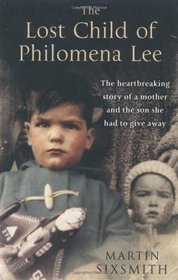
 The Lost Child of Philomena Lee, by Martin Sixsmith
 With the success of the movie "Philomena," this book was reissued as Philomena with a cover showing Dame Judi Dench and Steve Coogan, the actors who play Philomena Lee and Martin Sexsmith in the film. The book, which came first, is not really about Philomena. It's about her son Anthony, known as Michael Hess in the United States.
Although I found the book to be mostly fascinating, it is decidedly not nonfiction. As a fictionalized account of Michael Hess' life, British journalist Sixsmith took extreme liberties with the story...inventing dialogue and fabricating scenes that didn't actually happen. I looked in the back to see his sources, but no interviews, letters, or other paperwork were cited. We know he interviewed people, but one of his key sources, Susan Kavanaugh, has said that he made up a lot of what's in the book and painted Michael's character in an unflattering way. How could Sixsmith have known what Michael said confidentially to his therapist and priest in confession? He should have stated at the outset that this was a fictionalized account of Hess' life.
With that said, I found Michael's story to be moving and interesting. I learned a great deal about the beginning of the AIDS epidemic, the inner workings of the Republican party during Reagan's tenure, and the Irish Catholic church. I already knew about the Magdalene laundries and found the beginning of the book to be fascinating and heartbreaking, as Philomena Lee's beloved son is ripped away from her...and she was powerless to prevent it. I saw the film "The Magdalene Sisters" back in 2003 and know the Joni Mitchell song well. Watch this 5-minute video with the song, which gives more information about the Magdalene laundries. The Catholic church has never taken responsibility for these abuses, and staunch Catholic defenders either defend the practices or deny that any abuses took place. In fact, young women and girls (such as Sinead O'Connor) were enslaved in these Catholic-run prisons until 1996.
 In my research, I was glad to discover that Philomena Lee met Pope Francis recently, giving her a sense of closure:
"I felt such a sense of relief yesterday for the guilt I carried and that I still carry a little bit today," said Lee on Thursday, a day after the audience. "Because you were made to feel so, so bad about having a baby out of wedlock. "He really made me feel so good inside because I carried the guilt inside me for 50 years, without telling anybody."However, the Catholic church has yet to issue an apology or validate the abuses suffered in its name.
Back to the book. One quibble I had, echoed by Michael's friend Susan Kavanaugh, is the author's near-obsession with Michael's sexual practices. He is portrayed as a sex-obsessed, promiscuous. and thrill-seeking gay man who is incapable of staying faithful to his partners. That might be true, but we have no way of knowing where he got his information. It's almost as if he's implying that Michael contracted AIDS because of his sexual behavior. He also infers that Michael is never satisfied and cannot make a commitment because he is tortured by being abandoned by his mother. That seems to underline every single activity in Michael's life...that he didn't deserve to be happy. In spite of this, Michael led a highly successful career (as a closeted gay man and supposed Democrat) in the Republican party and the White House. That must have been enough torture for him--as he heard all sorts of homophobia, hatred, and AIDS jokes from the party itself and the religious right. One Goodreads reviewers put it well:
"Having stuck this very bad book through to the end, I really would have liked to understand Michael/Anthony's true character but perhaps only glimpses of that can be extrapolated from Sixsmith's words. He portrayed Michael on the one hand to be generous, witty, fun loving, brilliant, sensitive and on the other to be moody, self destructive, dangerous and insensitive. Completely misleading and contradictory. If a writer can't truly get to the heart of someone's character, then do bereaved friends and family still living a courtesy and don't write about character at all. If Sixsmith had focused on Philomena's quest rather than trying to fabricate a dead man's personality, he would have been more in his element."Finally, Sixsmith's writing was choppy and didn't flow together well. In a few early chapters, we learn about a civil servant who is trying to stop the tide of Irish babies being sent to the USA to be adopted...Sixsmith alludes to his man's unhappy marriage as well, but to what point? He drops out of the story. We also never hear about Michael's relationship with his brothers later in life...one of them mercilessly bullied him as a young child. We know he doesn't include them in his will, but that's about it. Sixsmith also wrote a couple of chapters in first person as he described how he wrote the book--this totally threw me off and confused me until I figured out who was speaking. These chapters would have been better put in an introduction.
I would have liked to have known more about Michael's sister Mary in her later years. She is mentioned a few times and comes to see Michael at the end of his life. Given the fact that she was the most important person in Michael's life--and she is still alive--why didn't we get more of her story? I can find little about her on the Internet.
 |
| Judi Dench with Philomena Lee |
I was annoyed by the ending, in which Sixsmith mentions Anthony/Michael's father...he alludes to the fact that his father might have been discovered, but says that is a topic for another book. What the hell? That is definitely not enough for another book. Why not share the information in this book??
 |
| Philomena Lee at her son's grave |
Both Michael and Philomena stalled in their efforts to find each other. The Catholic church and the Irish government were not helpful. In fact, if the book is correct, Philomena found out about her son when her daughter Jane spied a photo of a new gravestone on the convent grounds. That small lead led to this story.
I give the real Philomena Lee and Michael Hess, both fascinating characters with interesting lives, five stars. The book gets two or three, because the story was compelling...but loses a lot in the telling.


 Pomegranate Soup


