Showing posts with label India. Show all posts

Monday, April 20, 2020

Catching Up: Great Fiction Reads

I have gotten really behind with my book reviews, and it's hanging over my head! So in this post and the upcoming ones, I will attempt to catch up with what I've read in the past several months. First, a fiction roundup!

The Testaments, by Margaret Atwood

Judging from some of the reviews on Goodreads, many readers believe that this sequel to The Handmaid's Tale was unnecessary, similar to what they said about To Kill a Mockingbird. A writer always takes a huge risk writing a sequel to a beloved, highly acclaimed novel. Even when they write a different type of book (e.g., JK Rowling writing A Casual Vacancy after Harry Potter), they are skewered in the reviews because it was not what readers expected. I find that reaction to be tiresome!

I actually really liked The Testaments and found it to be a suitable conclusion to The Handmaid's Tale, and it complemented the Hulu series well. The story takes place 15 years after the founding of Gilead, and it is told from the perspectives of three different people, including Aunt Lydia. If you prefer endings that are unresolved, stay away from The Testaments. If you'd like to see a resolution for Offred and others, and get some hope, read this sequel.

Sweet Bean Paste, Durian Sukegawa

I loved this sweet story of Sentaro, an ex-con who runs a doriyaki shop, and Tokue, a woman who has Hansen's disease, otherwise known as leprosy. Although I lived in Japan in the late 1980s, I was not aware that people with leprosy were isolated in sanitoriums and not allowed to mingle with the public until 1996. Japan was one of the last developed countries to quarantine leprosy patients for life. Tokue was wise and resilient in spite of lingering discrimination and prejudice, and Sentaro's life was so much richer for his relationship with her. She shared her friendship so freely in spite of the way people treated her. I discovered recently that this book has been made into a movie (available on Kanopy), which I look forward to watching.

On the Come Up, Angie Thomas


I love Angie Thomas, author of The Hate U Give, especially after having her seen her in person when she was promoting this novel. On the Come Up is about Starr Carter, who has a true gift for rap, taking after her dad who was gunned down in the streets. She traverses a world of gang violence and school, where she feels like she can never get ahead. She's damned if she tells her truth through rap, and she's damned if she doesn't. Generally not drawn to rap because of the misogny in much of it, I now have a much greater appreciation for the art of hip hop. It is poetry, and rappers are gifted artists, even if I don't always like what they are saying. I will read everything Angie Thomas writes.

Women of Juarez, Sam Hawken

After seeing the gripping play "La Ruta" at the Artist's Repertory Theater in November, I was determined to read more about the missing and dead women of Ciudad Juarez. That's how I found The Dead Women of Juarez, a gut-wrenching, dark story narrated by a washed-up addict American boxer Kelly Courter who is love with a Mexican woman, Paloma, and gets wrapped up in organized crime and drug dealing. It's difficult to read, violent, and sad, but I would expect nothing less given that it's about the feminicide in Ciudad Juarez, one of Central America's great tragedies of this century. This book stuck with me for a very long time.


A Man Called Ove, Fredrik Backman


It took me a while to appreciate Ove and like him as a character. I don't have a lot of patience for curmudgeons who only like things to be done a certain way and who can't abide change. I appreciated the way Backman gradually peeled the layers back on Ove's character, so we could understand what contributed to his difficult personality. In the end, I was cheering for him along with all the other readers.


I Am Not Your Perfect Mexican Daughter, Erika L. Sanchez

As a Mexican-American girl, Julia feels that she can never measure up to her sister Olga, now dead. She does not feel loved by her grief-stricken, stressed-out parents, and as an adolescent, she's actually not very lovable at times. As she unravels the love-hate relationship she had with her "perfect" sister Olga, she also unravels the truth of Olga's life. She wasn't as perfect as everyone thought.

I chose this book as the first in a series of "Voices from the Margins" for a book group I led. This is a strong young adult novel about contemporary Mexican-American girlhood and an easy read.


Before We Were Yours, Lisa Wingate

Before We Were Yours is based on the Tennessee Children's Home Society, a horrible case in which director Georgia Tann kidnapped and sold children. Always fascinated by historical cases like this, I was gripped by this story.

I did find one of the main characters, Avery Stafford, to be supremely annoying. This was one of these southern books I felt really lacked understanding or awareness of race (like The Help). For example, one scene takes place in a slave cabin...and the characters (and presumably, the author) didn't seem to see any parallels between all the Black children that were kidnapped and sold...a far bigger scandal than the Tennessee Children's Home Society. This lack of awareness tainted the book for me.

The Satapur Moonstone, Sujata Massey

The Satapur Moonstone is another great book by one of my favorite authors, Sujata Massey! The second in her Perveen Minstry series, The Satapur Moonstone follows up The Widows of Malabar Hill. As Bombay's only woman lawyer, Perveen is given special access to women in purdah. Set in 1922, this adventure takes Perveen up into the remote mountains, where she acts as a liaison between the royal family, beset by tragedy, and the British agent there. I read everything Massey writes, whether it takes place in Japan or India, and I'm never disappointed! Minstry is a strong, independent, and bright professional woman in a man's world, and she bristles against British colonial rule and patriarchal traditionalism while knowing she must be careful to not be too obvious about her views, lest she lose clients. I look forward to the next book in the series.

The Great Alone, Kristin Hannah

Compulsively readable, The Great Alone is about a family who ventures off to the wilds of Alaska, completely unprepared, and once there, is forced to face the demons of PTSD, domestic violence, and mental illness. I really enjoy Kristin Hannah's writing, and this book was hard to put down. It reminded me of Jon Krauker's Into the Wild...a man who doesn't fit into the Lower 48, seeking his fortunes and answers in the wilds of Alaska. Not an easy book to read, though, because of the domestic violence.

We Have Always Lived in the Castle, Shirley Jackson

Most people know Shirley Jackson for her short story, "The Lottery," like me. From what I've read about Jackson, she was a fascinating, quirky person. This short novel fits that description as well. It's the story of two sisters, Mary Catherine and Constance, who appear to be agoraphobic and highly unusual. Their family has been struck by great tragedy. Jackson brilliantly unravels the mystery, one layer at a time. Spooky, mysterious, weird...another book group choice by my friend Katie. This is a great example of why I like being in a book group...I had never even heard of this book, and Katie had read it as a y oung person. I liked it!

My oldest son, Christopher, just watched Jackson's "The Haunting of Hill House" on Netflix, and liked it. Adding it to my list!


The Sun Is Also a Star, Nicola Yoon

The Sun Is Also a Star was another young adult read I chose for the "Voices from the Margins" book group, and all of us enjoyed this day in the life of a Jamaican-American girl, Natasha, whose family was due to be deported. She meets a romantic, idealistic Korean-American boy, Daniel, whose views of the world sharply contrasted with her own science- and reality-focused beliefs. As children of immigrants, both Daniel and Natasha are far more American than their parents, and certainly far more American than Jamaican or Korean.

This is the kind of book that makes you almost cringe at the number of coincidences...but outside of that, I loved it. It reminded me a bit of The Fault in Our Stars, but the immigrant version...so even more interesting.

“I don't believe in love."
"It's not a religion," he says. "It exists whether you believe in it or not.”
― Nicola Yoon, The Sun Is Also a Star

The Power, Naomi Alderman

This book blew my mind. The Power is a dystopian novel, imagining what it would be like if women had a course of power running through their collarbone, capable of great strength and power. I read it for my book group, and it produced an outstanding discussion.

Some found the book to be highly disturbing (there is a great deal of violence), and all of us found it incredibly creative and thought-provoking.

As women, we would like to think that if we were in power, the world would be a more compassionate, gentle, and civilized place. This book turns that theory on its heel...but as I argued in our book group, the women who were most likely to use their power for harm were the ones who had been horribly abused by men or male power structures. So it's not an apple-to-apple comparison. The book lays bare the broad, damaging effects of the patriarchy, and does it in sometimes subtle, sometimes overwhelming ways. This book will stick with me for a very long time, much like The Handmaid's Tale. It's actually an antithesis to The Handmaid's Tale.

Tuesday, December 16, 2014

The Hundred-Foot Journey

The Hundred-Foot Journey,
by Richard C. Morais


I found this at the library and thought I'd read it before seeing the movie, as is my habit! Turns out that Richard C. Morais wanted to make a film even before and while he was writing the book.

I loved the first half of the book...the colorful depiction of Indian cooking, Hassan's relationship with his family and then Madame Mallory, and the process of running a restaurant in India and then France.

But AD (after the deaths of both Hassan's feisty father and the equally feisty Madame Mallory), the book slumps. It takes us, very quickly, through Hassan's trajectory of becoming one of Paris' top chefs. Much of the fancy French cuisine, heavily butchery and innards-focused, does not sound very appealing to me. The second half of the book focuses on the Paris restaurant scene and the process and snobby politics of earning Michelin stars.

Hassan seems more devastated by the death of another character than his own father or most significant mentor. Morais also confesses that he didn't go to India until after he'd begun writing the novel, and then only for 10 days. This is evident to me, not in the way he describes Indian cooking but rather how he describes (or fails to) the culture. After Hassan moves to Paris, he's hardly even Indian any more. This doesn't seem realistic to me. I was hoping to have the author touch on the perspective of an Indian chef learning and practicing French cooking, and that just doesn't happen.

I've heard great things about the movie, so I'm looking forward to seeing that. I understand from friends that Madame Mallory does not die in the movie, and Hassan's also more in touch with his Indian roots.

Friday, February 7, 2014

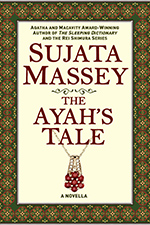
The Ayah's Tale

The Ayah's Tale, a novella by Sujata MasseyThe Ayah's Tale, by Sujata Massey

Sujata Massey, author of the wonderful The Sleeping Dictionary and the Rei Shimura series, has written a novella about the relationship between an Indian ayah and the English children under her care.

The role of a child care taker is a complicated one. During a few summers in college, I worked as a nanny taking care of my two cousins in Seattle. I also babysat extensively during high school and formed strong attachments to many of my charges. When I left my two cousins at aged 2 and 4 to go to Japan, I sobbed because I knew how much I would miss them. I had grown very attached to both of them.

My situation was different than Menakshi, who was forced to drop out of school and take up a job as an ayah (nanny) because of her father's death and her family's poverty. Although she had great potential, she had to give up her own dreams to help her family.

Even though the children in her care were privileged and spoiled, she becomes attached t to them and they to her. What the children (especially middle child, Julian) don't understand is the complication in this attachment. The children's mother, Marjorie, is snobbish and shallow, and disengaged from her children's lives and inner thoughts. She doesn't want to spend much time with her children, but she also feels resentful because of their attachment to Menakshi, their ayah. The children don't understand that Menakshi is paid to be with them: it's not her choice, and she has her own life.

I always enjoy reading stories that take place in locations where I've lived or visited. Menakshi's story starts and ends in Georgetown, Penang in Malaysia, a place I visited in 1988. Sujata Massey beautifully depicts the life of an Indian ayah and the complicated relationships that people in the employ of their colonial employers had to deal with--and in fact, still deal with in many countries. 

Even though Menakshi endures great hardships in her life, she finds love in these pages and a more hopeful future than working as an unappreciated ayah. So even though her life improves, she feels some sense of loss as she misses these English children who came to love her.

I'm looking forward to Sujata Massey's next full-size novel. I prefer novels to short stories and novellas, although this was a fun one to read!

Wednesday, November 6, 2013

The Sleeping Dictionary

The Sleeping Dictionary (Daughters of Bengal, #1)
The Sleeping Dictionary, by Sujata Massey

As a long-time Sujata Massey fan, I was anxious to get my hands on her latest novel, and it did not disappoint!!

Sujata Massey was born in England to parents from India and Germany (just like my friend Nandita), and she grew up mostly in Minnesota. After working as a reporter, she spent several years in Japan where she taught, studied, and began writing her first novel, The Salaryman's Wife. That first novel grew into a detective series with smart, industrious, and savvy Rei Shimura, a Japanese-American antiques dealer who lives in Japan and solves mysteries on the side. I read every single one of the Rei Shimura novels as soon as they came out and have widely recommended them to friends. In fact, the Rei Shimura series is the only detective series I've devoured in its entirety outside of the VI Warshawski series by Sara Paretsky (my first introduction to detective novels). I'm not naturally drawn to mysteries, so I'm highly selective. Authors (e.g., Sue Grafton and Patricia Cornwell) lose my attention if their books are not well written or if I get tired of the main character. Of course, Rei Shimura held my attention completely because of the series' setting in Japan (mostly). Loved them!

So onto The Sleeping Dictionary. This book took six years for Massey to research and write, because it involved so much in-depth research into Indian history, culture, and language. Massey's family comes from Calcutta (now Kolkata) and she spent time there as a child (read her wonderful diary entries here!), so it was a natural choice for setting this novel. 

It's the story of Pom, who lives with her family in a small village by the sea. Her family is very poor, but she feels secure and well loved until a tidal wave wipes out her whole village and her family. Completely alone and helpless in 1930s India, Pom is a survivor. She ends up at a British boarding school, where she is renamed as Sarah and begins working as a maid. She learns how to read and write while operating the fan in a classroom. When she befriends a wealthier Indian girl, Bidushi, who she had known as a child, she comes to discover her own intelligence and talents. Although she hopes to become Bidushi's ayah and always stay together, these dreams are soon dashed by tragedy.

Still very young, she next finds herself in the city of Kharagpur, lured into prostitution at a high-class brothel. As an Indian girl without a family, she has few options for survival. She desperately tries to cling to her dignity in the midst of her despair at being forced to sell her body, and she continues to nurture dreams of becoming a teacher. (The title of the book comes from the term for young Indian women who slept with British men and taught them the ways and language of India.)

I hesitate to give away too much of the plot and adventure in the novel, but I will say that she moves to Calcutta where she renames herself as Kamala, begins to work for an English man, and gets involved in the Indian independence movement.

So here are some of the reasons why I loved this book: 
  • Pom/Sarah/Kamala is a strong, spunky Indian female, and I found myself rooting for her immediately and throughout her story. Faced with desperately difficult choices in her life, she does the best she can with what is given to her. While she is certainly a victim many times in her life, she has no privilege to wallow in misery and self-pity, but time after time she finds ways to rise above her difficult circumstances.
  • I could practically taste Calcutta through Massey's detailed descriptions of the city. I've traveled only in the north of India (we concentrated our time there in Delhi, Agra, and Rajasthan), but I found myself intrigued by the City of Palaces and sad to read about its devastation during the pre-Independence riots and violence.
  • I have read great quantities of Indian fiction (and a bit of nonfiction, too), but this book taught me things I did not know...for example, about the massive famine in Bengal caused by the British Empire hoarding India's rice (millions died), India's amazing female freedom fighters and independence activists, Japan bombing India during the war, some members of the Indian resistance movement joining the Japanese led by Subhash Chandra Bose, to name a few...it also gives the Anglo-Indian perspective on what was happening during that time.
  • Massey develops multidimensional characters, including Hindus, Muslims, and British, and even some of the women who are sucked into prostitution. Kamala herself makes some unfortunate decisions and lies to people because she feels she has no choice. She's a complex character who is far from perfect. Both Kamala and Simon evolve through the story. There's even a Scottish clergyman who is open minded, fair, and compassionate...imagine that!
  • As a consummate book lover, I enjoyed the sheer love of books in this novel. From the moment "Sarah" borrows books from a kind teacher at the British boarding school and her gradual collection of the great masters, to Kamala landing a wonderful job as a librarian for Mr. Lewes...books offer her an escape from the great losses in her life.
I was excited to learn that this book is the first in a planned trilogy, AND that Rei Shimura will be making a reappearance! The Sleeping Dictionary will be near the top of my "Top Reads of 2013" list! If you enjoy reading historical fiction or books about India, the colonial era, or strong female characters, give it a try! 

Here is Sujata Massey speaking about The Sleeping Dictionary, and an interview with her.


Tuesday, September 3, 2013

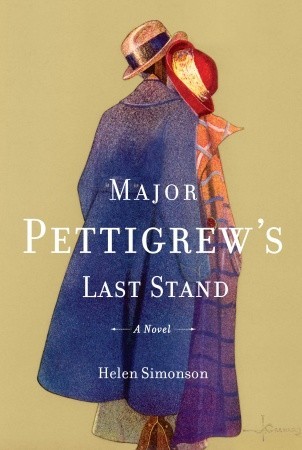
Major Pettigrew's Last Stand

Major Pettigrew's Last StandMajor Pettigrew's Last Stand, by Helen Simonson

This book was my book group's selection for August. Major Pettigrew is an old-school English military man, of the type we wouldn't typically find in the United States. He insists on being called "major," even by civilians. As a widower and father of a shallow, materialistic son, he doesn't seem to have much purpose in his life until he finds late-blooming love.

The object of his affection is a Pakistani shop keeper in his small village, Mrs. Ali, also a widow. Of course, the narrow-minded villagers, along with Major Pettigrew's and Mrs. Ali's own family members, do not think very highly of their blossoming relationship.

Major Pettigrew's Last Stand has been described as Austenesque, and I would agree with that. Two unlikely lovers, humorous (and horrifyingly obtuse) situations and people in the midst of serious issues, and exquisite storytelling. We had an interesting discussion at my book group meeting about how English this story was...the English woman in my book group didn't necessarily agree, but I think many things about the story are quintessentially English. Perhaps it's just a matter of a small English village--even our American small towns are not quite the same way--or the class structure so firmly entrenched in English culture and history.

Although Major Pettigrew starts out as an uptight English snob, he evolves during the novel.

The ending seemed a bit far-fetched, but I still enjoyed this book and would recommend it!

Monday, July 9, 2012

Miss New India

Miss New India, by Bharati Mukherjee

I picked this up at the library, intrigued by the premise and undeterred by the lukewarm (and sometimes outright negative) reviews on Goodreads. A novel about Bangalore, call centers, and the new Indian woman? Sure--sounds promising. I've read other Mukherjee novels and liked them, so I thought this was worth a try.

Sadly, this was not a winner. The main character, Anjali, is not likable and she's completely shallow...which I could live with, perhaps, if I cared anything about what happened to these characters. Once she made it to Bangalore, I lost track of some of the characters--they just were not drawn vividly enough--and then when the Bagehot House fell, I began skimming.

Why were all these people helping her? Anjali was ungrateful, not particularly talented, and lackadaisical, but everything seemed to go her way in the end, which seemed too good to be true.

Minnie, Anjali's obnoxiously snobby landlady, reminded me of a woman who ran a hostel in Jaipur, India. I believe she was Anglo-Indian as well. I remember that she "kindly" invited us to stay to dinner. The next morning when we were ready to leave, she presented us with an exorbitant bill for that dinner!

This book could have been so much better. I'm fascinated with the idea of the new India, but this was an uneven, shoddy attempt for a well-known and accomplished author. Disappointing.

Tuesday, April 24, 2012

Behind the Beautiful Forevers


Behind the Beautiful Forevers: Life, Death, and Hope in a Mumbai Undercity, by Katherine Boo

This is an astonishing, ground-breaking book. Katherine Boo, an award-winning American writer/reporter who has earned accolades for reporting on the poor, married an Indian man, Sunil Khilnani. They spend half of their time in the U.S. and half in India.

Over three years, she spent countless hours shadowing the residents of Annawadi, a slum near the Mumbai airport filled with people without permanent work...each one of them struggling to make a living, mostly through garbage picking and recycling, temporary jobs, and theft. With the help of translators, she gradually got to know Annawadi's residents, and they finally got used to having the strange white woman around.

As she grew to learn their stories, a few stood out. Central to the book is the story of Abdul, a young Muslim who buys and recycles the garbage that others collect, whose family is accused of a crime by their angry neighbor. Manju hopes to become Annawadi's first college grad, but she's disturbed by her mother's constant conniving and corruption (which actually assist in paying her college bills). Kalu, a young thief, entertains the other boys by acting out scenes from Bollywood movies. A young woman commits suicide with poison to avoid the arranged marriage her family has made for her. As a Dalit, she knows that her life in a small village away from relatively progressive Mumbai will be miserable.

From Boo's web site
What struck me most about this book, more than the extreme poverty, lack of sanitation, and struggling for subsistence on the edge of the sewage lake, was the horrible corruption rife in Indian politics, law enforcement, business, and civil service. This, even more than the poverty, oppresses the disadvantaged and prevents them from advancing out of the slums. It made me think of the anti-corruption policies my company has in writing, and ponder how it does business in India or the Middle East without resorting to bribes. According to this book, when you give money to charities such as World Vision or Christian orphanages, you're lucky if the donation actually reaches the needy. Schools employ teachers without college educations (or even high school degrees), and the only way to get a government teaching job is to pay huge bribes. Boo writes about a nun who runs an orphanage and resells many of the clothes, food, and toys she receives for the children.

When Abdul and his father and sister are accused of inciting a spiteful neighbor woman to set herself aflame, everyone crowds in to make some money. They are tortured in jail and told, by many, that if they pay money, the problem will go away. Abdul's mother even goes directly to the other family to negotiate, but they believe they'll be able to extort more money through the courts.

From Boo's web site
This book is written like a novel even though it's hard-core, investigative reporting. Boo and her translators are completely invisible narrators. She took meticulous notes and recordings and documented her research thoroughly--important in the age of Greg Mortensons and the accusations thrown around about the "white savior complex." Boo's purpose was to shine the light on the Annawadians themselves and their environment instead of the white writer. Boo was threatened by the police and often felt insecure or threatened as she did her research. This book does not make the Indian government smell good.

And beyond that is an examination of the modernization and regentrification of India. Annawadi is located within sight of the huge, fancy Mumbai airport hotels, behind walls plastered with ads for ceramic tile that say "Beautiful Forever." As young Mirchi (Abdul's younger brother) is quoted in this review from The Times of India, "Everything around us is roses, and we are the shit between." Hovering over Annawadi and its residents is the constant fear that the slum--and their homes--will be leveled and destroyed.

This book has made me look at India and my own existence in a new way. It begs the question of what can be done to eradicate such corruption and extreme poverty in the world. It also makes one think about the price of affluence. When the economy began suffering, the Annawadians suffered as well. Yet on the other hand, what is the price of progress as the gap between rich and poor grows and grows?

For more information about Katherine Boo and this book, I encourage you to visit her web site, listen to this interview on NPR, or watch this video. This book and its stories of these desperately hard-working people will stick with me for a very long time.

Friday, May 13, 2011

Cutting for Stone: Twins, intertwined at birth and through difficulty and betrayal

Cutting for StoneCutting for Stone, by Abraham Verghese
My rating: 4 out of 5 stars

It always amazes me when someone whose primary profession is not writing manages to write a highly ambitious, sweeping saga of a novel like Cutting for Stone.

Abraham Verghese is a surgeon by trade, and it shows in this book. It's full of painstakingly detailed, sometimes graphic medical procedures. Fortunately, they are written in a way that a layperson can understand. It's not a book for the squeamish, which you will realize once you get into the first couple of chapters.

Cutting for Stone is about twin boys, Marion and Shiva, who are born to an Indian nun and a British surgeon. After their mother dies and their father runs off in grief, they are raised by two other doctors (Ghosh and Hema) at "Missing Hospital" in Addis Adaba, Ethiopia. Extremely different from one another but bound together from birth through blood and an invisible line between their heads, the brothers experience loss, betrayal, and distance.

Other reviewers were troubled by the narrator perspective of Marion, and I agree that at times it was jarring (especially when Marion was unconscious at one point!). Shiva in particular is very difficult to fathom at times, because of the singular perspective of his twin brother.

Marion has an obsessive love for Genet, his nanny's daughter, although it's difficult to understand why at times. She takes his affection for granted, and in one troubling scene, he has violent sex with her, I suppose as his way of getting even with her.

Verghese is an excellent descriptive writer--he's able to paint a canvas full of interesting, colorful locations--India, Ethiopia, the sea, New York, Boston--in addition to his ability to place you right in the operating room.

The book dragged for me at times, and I found the beginning and the end to be the most gripping.
As the aunt of twin boys and the friend of someone who bore twin girls and lost one on the day of her birth, I have seen twin kinship in action. I wonder whether Verghese is a twin or is close to twins. He seems to have a genuine understanding of the invisible bond between people who shared their mother's womb. When Marion fell ill, Shiva could sense it from a world away, in spite of the fact that they were somewhat estranged. This did not surprise me.

Even though this book took me awhile to finish (because of its length and at-times slow pace), I thought about it when I was not reading it--always a good sign.

As someone who has experienced the unique agony of having a loved one be medically fragile and close to death, I appreciated Verghese's efforts to express this perspective.

At one point, Thomas Stone (father of the twins) shares a letter from her mother about her son dying in surgery, and no one offered him any words of comfort--"Before I was asked to leave the room in a very rough manner, I must tell you that I saw my son was terrified and there was no one who addressed his fear...I saw no sign of the slightest bit of human kindness. My son and I were irritants. Your team would have preferred for me to be gone and for him to be quiet....My son's last conscious memory will be of people ignoring him. My last memory of him will be of my little boy, watching in terror as his mother is escorted out of the room. It is the graven image I will carry to my own deathbed. The fact that people were attentive to his body does not compensate for them ignoring his being." This so perfectly captures the feeling of desperation felt by a parent whose child is not being cared for with compassion, respect, and understanding.

Later when Marion was deathly ill, Shiva lay down next to him on his hospital bed, head to head, as they lay in the womb and during childhood...and Marion's intracranial pressure went down immediately. This is akin to those times when we would visit our premature son in the NICU and he would feel our presence--his oxygen saturation would go up.

Even during the times when Thomas Stone and his son, Marion, led solitary, reserved private lives, they displayed the kinder, more human side of medicine.

Thursday, February 10, 2011

The Dead Hand: Making me think of Mother Teresa in a new light

A Dead Hand: A Crime in CalcuttaA Dead Hand: A Crime in Calcutta, by Paul Theroux

My rating: 2 of 5 stars

I first discovered Paul Theroux back in my early 20s when I was living in Japan and traveling through Asia. Theroux wrote about his adventures on the Trans-Siberian Railway across Asia and Russia in The Great Railway Bazaar, the fascinating book that launched the travel memoir industry. I also read Riding the Iron Rooster about Theroux's travels in China. Theroux is a keen observer of different cultures, traditions, and people. Back in those days, Mike read his novel Saint Jack, but I do not recall reading it. Theroux also wrote the book The Mosquito Coast, probably the most famous of his works because of the movie.

So I approached A Dead Hand with some experience of Theroux. His insightful observations and colorful descriptions of India were the best part of this book. It's the story of a travel journalist, Jerry, who is slumming in Calcutta...waiting for the next freebie hotel stay and experiencing writer's block (one reason for the novel's title). He receives a letter from a wealthy American woman, Mrs. Unger, who has adopted many of India's customs for her own. (She wears a sari and henna tattoos, practices tantric and sensual massage, and eats only Ayurvedic food.) A friend of her son had woken up in a hotel room one morning and discovers a dead body on the floor. He had panicked and run away. She professes admiration for Jerry's writing and because of this, asks him to investigate the situation, presumably to clear the boy's name.

He soon enters into an odd romantic relationship with her, whereby she summons him when he fits into her schedule and shares only tiny, strange tidbits of her life. Even though she claimed the investigation of the dead body was her primary purpose for contacting him, she soon seduces him into being her devotee. Jerry becomes completely besotted with her, and we have pages and pages ad nauseum where he writes about how pure and saintly she is. Blah.

Mrs. Unger (always called by this name) arrived in India to work with Mother Teresa at the Missionaries of Charity. She hates Mother Teresa and badmouths her to Jerry. (For this reason, many have called this book anti-Catholic.) (And now a little diversion about M. Teresa...)
What I was not aware of before reading this book was that Mother Teresa was a highly controversial figure. She collected millions of $ for her charity, but very little of the collected funds went to help the sick and poor. Nearly all of it was given to the Vatican. She did what she did for her beloved church. (And as many have written, those funds given for the specific purpose to help the poor and destitute have instead been used to defend pedophile priests.) Mother Teresa believed that to be poor is to be holy. She did not allow her sisters or other workers to spend money on improving their own lives or the lives of the poor and sick. Google searches for "myth of Mother Teresa will yield all sorts of disenchanted stories and experiences, such as this one
Mother Teresa was also heavily anti-abortion and anti-birth control and reproductive technologies. Much of what's on the internet is hardly objective or from respected authorities, but here's an article in the New Statesman about the squalid conditions in her homes. I certainly will think differently of her from now on.
It's ironic that Mrs. Unger criticizes Mother Teresa, because she turns out to be far worse than the tiny nun...as of course, the reader could see coming a mile away.

I was not very impressed with the plot of this book...it meandered all over the place, and some parts were more interesting than others. On the pages and pages where Jerry blathers on about what a saint Mrs. Unger is, or about how he's able to write again, I felt bored to the point of scanning. As apparently is typical for Theroux, he includes a scene with himself in the book. This is a bit weird, and if it were a better book, or if I could understand the point of the scene better, I would have accepted it more. I believe that Theroux meant this book as an indictment on white rich people dabbling in developing countries, swooping in to help the poor and destitute...while actually hurting them. He is missing the point, though, by ignoring all of the reputable and indeed-helpful white people working in the developing world, providing sustenance and support to millions of people.

Theroux needs to hit the road again and go back to writing nonfiction. Or maybe he's just past his prime.

Tuesday, November 30, 2010

Serious Men: Meh...

Serious Men: A Novel1 of 5 stars

I'm an Indian fiction nut...so when I saw this at the library, I had to check it out. It started off well enough, but then I kept debating whether I should continue because I found myself wishing I was reading something else. Never a good sign. But continue I did. I've since started a new book (Supermarket by Japanese novelist Satoshi Azuchi) and realizing how disappointing I found Serious Men.

Serious Men chronicles the lives and trials of two men in Mumbai. Ayyan Mani, a dalit (formerly known as untouchable) lives in the slums with his wife and son while working in the Institute of Theory and Research as an assistant to the director. He spends all day serving snobby Brahmins, whose caste is responsible for the historic degradation and humiliation of the dalit. His anger is ready to boil over, but he finds small ways to take revenge. I found Ayyan Mani's story--and his sneaky, deceptive ploys to gain attention for his partly deaf son--to be the most interesting part of this book. The fact that others did not see through his deception, I believe, is meant to be part of the satire.

The director, an arrogant astronomer named Arvind Acharya, has his own problems. He's dealing with office politics on a daily basis, as the other scientists attempt to overthrow his regime. He ends up falling into an affair with the only female scientist, Oparna, which threatens to destroy both his marriage and his career.

I found myself scanning over the pages of scientific debate about extraterrestrial life and the politics of which research projects should be funded...boring. Perhaps I would be more interested if I were a scientist? It's possible, but even science can be written about in a more interesting way.

What ultimately gave the book one star in my mind, though, was the sexist and demeaning portrayal of the women characters. Ayyan Mani's dull wife is addicted to soap operas and believes any yarn he spins her. He married her to get away from the clutches of modern women with whom he was sleeping. Acharya's wife is the most believable--she is way more grounded than her husband--but after she finds out about his affair, she fades away, presumably accepting her lot in life.

But the worst was the character of Oparna, who is introduced as a brilliant, independent, and strong woman. When she threw herself at the old, "fat" director, I didn't buy it. As a woman who has never been attracted to much-older, more powerful men, this plot line did not ring true. I found their sex in the basement to be repulsive. Then after Acharya ended the affair, she decided to ruin both of their careers by fabricating a lie about their dual research project. Manu Joseph clearly scorns modern, independent, single women.

These passages are a few examples of the way Joseph feels about his women characters--Ayyan musing on how he escaped the risky option of relationships with modern women:
"Free love, Ayyan knew in his heart, is an enchanting place haunted by demented women. Here, every day men merely got away. And then, without warning, they were finished. The girl would come and say, like a martyr, that she was pregnant, or would remember that all the time she was being raped, or her husband would arrive with a butcher's knife. Such things always happened in the country of free love. Ayyan Mani had fled in time from there into the open arms of a virgin. But Acharya had fled the other way."
Oparna on facing a jury of scientists to discuss her allegations against her ex-lover:
"She wondered how women would have handled this situation. What if the jury had been comprised of menopausal women? That was a disturbing thought. They would have butchered her in a minute. But this jury of ageing men was going to be easy."
And a description of Oparna's lot in life:
"She would wander through life beseeching men to love her, frighten them with the intensity of her affection, marry one whose smell she could tolerate, and then resume the search for love. And she would suffer the loneliness of affairs..."
I rarely give one-star ratings to books, because I research them before I read them (too little time to read, so why read trash?). This had so much potential--it could have been great social satire and commentary on the lot of dalit and the hypocrisy of modern science and office politics--but ultimately disappoints.

Friday, October 1, 2010

Secret Daughter: great story about Indian-American woman who finally discovers her roots

Secret Daughter by Shilpi Somaya Gowda

My rating: 4 of 5 stars

A poor Indian village woman (Kavita) gives birth to daughters, while her husband (Vasu) and his family only want a son. Her first daughter is taken from her and buried alive before she can even hold her. When she has a second daughter, Kavita and her sister make a long journey on foot to Mumbai (formerly Bombay), where they have an emotional parting at an orphanage.

In the meantime, across the globe, a Californian physician named Somer suffers from a series of miscarriages and learns she will never be able to carry a baby. Her Indian husband, Krishnan, finally convinces her to consider adoption. They make their first trip to India together to visit Krishnan's family and adopt a baby girl, Asha, who had been born to Kavita and Jasu.

Some have criticized this book because Gowda tries to tackle too many years (a 25-year time span) in too few pages (about 340). She also switches back and forth between characters' perspectives. It's a little clunky, I must admit, and it took me some time to get used to it and settle into the story.

Some of the characters could have been more developed...a task that might have been easier had there not been so many perspectives or years covered. For example, what was going on with Kavita and Jasu's son, Vijay? How did he become who he was? We meet handsome economist Sanjay in Mumbai, but don't get a clear picture of who he is...similar to Asha's cousins and her mentor, Meena. Her grandfather hardly says a word in the book, and presumably she grows attached to him, but we're not really sure why because we don't glimpse any of their interactions. Perhaps the book was too ambitious in trying to cover too much.

Asha grows up and chafes against her parents. Somer and Krishnan grow apart, especially after Asha leaves for college. Kavita and Jasu have their long-awaited son, who turns out to be a disappointment. They move to Mumbai and continue to live in poverty for most of their lives.

I found the character of Somer to be annoying. She's the only major American character in the book, and some of her choices don't ring true to me. She marries an Indian in the 1980s, yet has no interest whatsoever in visiting India, getting to know her Indian relatives, or eating Indian food? Asha reaches the age of 20 without ever having returned to India. I can't imagine depriving a child of his or her grandparents for 20 years, not to mention not teaching her about her rich cultural heritage. Although the book begins by describing her heartbreaking battles with infertility, Somer was the least well-developed and believable character in the book.

For me, the story came alive when Asha went to work in India for a year on a college fellowship. She meets and gets to know her large Indian family and wise grandmother, and she also comes to appreciate her parents and better appreciate the choices they made.

Gowda also sensitively tackles the extremely difficult issue of females in India, from Kavita having her daughters ripped away from her because they were not male and experiencing scorn because she had not borne a son...to the abject poverty and crippling conditions poor Indian women suffer...and the apparent power wealthier Indian women wield in their own families, yet they are still stifled by social structures and taboos. Asha comes to realize how much more freedom she has had as a woman, growing up in the U.S. instead of India. As Asha's mentor, Meena says, "Mother India does not love all her children equally, it seems." At the same time, Gowda balances the horrific challenges women face in India with the beautiful parts of the culture and the importance of family.

In spite of the book's weaknesses, I'm giving it four stars...because I couldn't put it down. I will read more of Gowda's books. For me, the most important thing about a book is how much I enjoy reading it...how much it sticks with me throughout the day, and whether I think of it when I wake in the middle of the night. This book did those things for me, so I consider it a good read.

Chowpatty Beach, one of the sights Asha visits during her year in Mumbai

Saturday, September 25, 2010

In the Convent of Little Flowers: A short story collection I actually liked!

In the Convent of Little Flowers In the Convent of Little Flowers
by Indu Sundaresan

My rating: 4 of 5 stars

I cannot believe I am giving a book of short stories four stars. I am most definitely NOT a short story person. But these won me over.

I ended up with this book because I ordered it on Paperbackswap, and somehow it escaped my attention that it was a collection of short stories. So once I owned it, I had to read it! It was my first book by Indian-born Seattle author Indu Sundaresan, but it will definitely not be my last.

The stories--most of them about the lives of Indian women--were heartbreakingly sad and poignant, but beautifully written.

Concerning the Indian traditions of suttee, the banishment of widows, arranged marriage, women falling from grace for sex or pregnancy out of marriage, intercaste dating or marriage, parents giving up their lives and rights to their male children, etc., Sundaresan manages to evoke the beauty and flavor of India while also exposing its underbelly and the extremely difficult conditions women face there every single day.

As those of you who read my book reviews know, I am fascinated with India at the same time as I am horrified by its treatment of women. Mike and I got engaged there, and I have some fond memories of our month there, but at the same time I do not have a desire to return any time soon.

Reading stories like these makes me realize how fortunate I am to live in the U.S. and have the opportunities and freedom I have as a woman. They also make me wonder how I would react to the cultural restrictions and boundaries, not to mention the violence and abuse, imposed on women in countries like India...would I, like Sundaresan, have the courage to leave my country and make my home in a place where I could more freely express myself? Or would I not be the same spirited, opinionated woman I am today if I were born into a culture like that?
View all my reviews >>

The Palace Tiger: Joe Sandilands in India, but not at his best

The Palace Tiger (Joe Sandilands, #4)The Palace Tiger by Barbara Cleverly

My rating: 3 of 5 stars

Barbara Cleverly's Joe Sandilands series is about a British detective and former army man working in India during the time of the Raj. I found the first three of the series to be unique and colorful, portraying the evocative, fragrant era of 1920s India. As I've found with other series (such as those by Patricia Cornwell and Sue Grafton), though, this one is struggling to maintain its originality and verve. My interest is waning a bit.

The book opens up with an exciting scene: a person-eating tiger attacks a small Indian village girl. Soon we move onto the lives of the British ruling class in India and Joe Sandilands is sent by his supervisor down to a Northern territory where the ruling maharaja is dying.

I enjoyed the scenes of Joe engaging with Lizzie and Madeline, as well as the scene when Bahadur catches him by surprise while he was sleeping. But much of the story got bogged down in detail, especially the scenes involving just the British. At times I found myself ready for the book to be over so I could move onto something else, which is not a particularly good sign.

So I've been vacillating between 2 and 3 stars but ultimately decided on 3 because it was good...but not great. I'll read more of Cleverly--the Sandilands series has a unique premise and setting, and all of the characters--Indian, British, and American in this book--are equally considered as possible perpetrators.

I find also that Cleverly writes interesting, strong women characters, and it's clear to me that this series (although masculine in many ways because of the era) was written by a woman.
View all my reviews

Friday, September 24, 2010

Salaam, Paris: Meh

Salaam, ParisSalaam, Paris by Kavita Daswani

My rating: 2 of 5 stars

Indian literature seems to be very popular at the moment, and some books are better than others. The title of this book drew me in, but the story was not particularly deep or memorable.


View all my reviews

Thursday, September 23, 2010

Shooting Water: A Memoir of Second Chances, Family, and Filmmaking

Shooting Water: A Memoir of Second Chances, Family, and FilmmakingShooting Water: A Memoir of Second Chances, Family, and Filmmaking by Devyani Saltzman

My rating: 4 of 5 stars


Deepa Mehta's daughter wrote a memoir about working with her mother on the movie "Water," and also about her troubled relationship with her mom and how the (also troubled) movie-making was a redemptive experience for them.


View all my reviews

Water: Novel based on screenplay of the beautiful film

Water: A NovelWater: A Novel by Bapsi Sidhwa

My rating: 4 of 5 stars


Bapsi Sidhwa is a friend of the writer and director (Deepa Mehta) of the beautiful and sad movie "Water," and she wrote a novel based on the screenplay. I've read a number of Sidhwa's other books, and she is a talented writer. The story is tragic and heartwarming at the same time.


View all my reviews

The Damascened Blade: Joe Sandilands mystery #3

The Damascened Blade (Joe Sandilands, #3)The Damascened Blade by Barbara Cleverly

My rating: 4 of 5 stars

Yet another interesting novel by Cleverly--this one took me a bit of time to get into, but I enjoyed it once that happened. She must do an amazing amount of research to write these books, which take place in India during the time of the British Raj.


View all my reviews

Beneath a Marble Sky: One of my favorite books

Beneath a Marble SkyBeneath a Marble Sky by John Shors

My rating: 5 of 5 stars

Wonderful historical fiction about the building of the Taj Mahal. I wish I had read something like this before viewing the Taj...it would have made me appreciate it so much more!


View all my reviews

A Black Englishman: Satisfying story of star-crossed lovers

A Black Englishman: A NovelA Black Englishman: A Novel by Carolyn Slaughter

My rating: 4 of 5 stars

The author reimagined the tragic life of her own grandmother, who lived in India as an independent-minded young woman and fell in love with a British-educated Indian doctor. Full of gender and racial politics, and the dark strife during the time of the Raj in India, it was a satisfying, adventurous story of star-crossed lovers.


View all my reviews

Wednesday, September 22, 2010

All the Fishes Come Home to Roost: An American Misfit in India

All the Fishes Come Home to Roost: An American Misfit in IndiaAll the Fishes Come Home to Roost: An American Misfit in India by Rachel Manija Brown

My rating: 4 of 5 stars

I loved this memoir of a girl who was dragged off to an ashram in India by her parents at the young age of 7. Funny, well written, and evocative...

View all my reviews