Showing posts with label violence against women. Show all posts

Tuesday, August 25, 2015

Room

Room, by Emma Donoghue

I'm desperately behind in my book reviews, so I'm having a hard time remembering the details of the books...so forgive me for the brevity here.

I avoided this book for awhile, as I'd heard others talk about how difficult it was. I hadn't realized that Emma Donoghue had also written Slammerkin, one of my best books of 2005. Room is not as dark as many books I've read, so I'm not sure why I stayed away.

Room describes a mother's desperate love for her son and desire to protect him above all costs. "Ma" and Jack are in captivity for five years until she devises an escape plan. In the second half of the book, the two struggle to adapt to their new-found freedom. It illustrates power imbalance and violence against women.

Many readers dislike the simplified, child-like language Jack uses, and I agree that it is an odd choice. In my experience, only children tend to have more advanced vocabularies, not less advanced...and I would think this would be even more the case in this story, since Jack was Ma's only companion.

Being married to a Brit, I found a number of instances where British English snuck into a story supposedly set in the U.S.

But overall, I found this novel to be touching, thought provoking, and mesmerizing.

Thursday, January 23, 2014

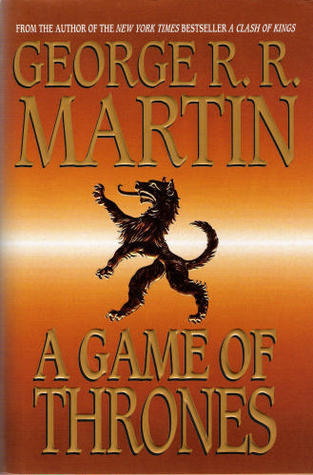
A Game of Thrones (and 10 reasons I disliked it)

A Game of Thrones (A Song of Ice and Fire, #1)A Game of Thrones, by George R.R. Martin

Or as I call it, A Game of Endless Unlikable Characters. 

My husband DEVOURS these books. When he's immersed in one of them, he doesn't pay attention to much else. He loves them.

Then my 17-year-old son, who used to be such a great reader but in recent years has been deterred by electronics, also read the whole book and is now watching the show.

Plus one of my close friends, who doesn't usually go for fantasy, became obsessed with the show and the books, and she told me that I should give them a try.

So I gave Book 1 a try, and I will not be reading any more of the series. Remember, I finished Book 1 of the Lord of the Rings series and gave up during The Two Towers. Fantasy is not my thing, unless it's something fun like Harry Potter. I can take the violence, and I have read many dystopian sci-fi novels. It's just that this didn't hold my interest.

I should have known better when in the beginning, every single chapter was told from the perspective of a different character. I have a 50-page rule (ala Nancy Pearl). I was about to give up, but then on Page 49, we returned to a character that I had seen before. So I plowed on, thinking I might become more engaged.

When I took a break at around Page 625 to read The Chaperone and enjoyed it much more, I should have known better. 

I also should have considered that my husband never thought I would like these books. 

But I was determined to finish the book, much like I felt that I needed to read Twilight. It's such a part of our popular culture, and I wanted to know why everyone seems besotted with it.

So here are the 10 reasons I wasn't crazy about A Game of Thrones:

1. Far too many characters!
I know Martin provides lists at the end of the book, but honestly, why did there have to be so many? I lost track. Many of the characters are mentioned in passing only once or twice. Why include them at all?

2. Lack of character development
Very few of the multitude of characters are fleshed out fully. Even the primary characters...we get very little back story on how they became who they are, with only a few exceptions.

3. Lack of sympathetic characters
The only person I cared about in this book was Arya Stark. That's it. I didn't care what happened to anyone else. Daenerys was interesting, but she was brutal too. Ned was better than most of them, but even he was not loyal to his wife and had a dark past. Nearly everyone in this book lacks morals, compassion, or kindness. These people are unlikable!

4. Rape and brutal treatment of women
I had heard that Game of Thrones had lots of sex, but I didn't expect the huge amount of rape and horrific treatment of women...constant child bride rape, incest, gang rape, and forced prostitution. Is this typical of fantasy? No thank you. I'd heard that this series has more strong female characters than other fantasy books, but even those strong female characters are often powerless in such a patriarchal, misogynist culture.

5. Too much detail
Martin goes way into detail about political posturing, history of various families, and geography, while sacrificing real, valuable information. And then there's the endless, repeated titles of royalty, such as "King Joffrey, the First of His Name, Lord of the Seven Kingdoms, and Protector of the Realm," blah, blah, blah. 

6. Way too long
I am not scared of long books. In fact, I loved Vikram Seth's 1,500-page long A Suitable Boy. But you've got to keep me interested to make me feel like the length is worth it. This book could have used a good editor. (See #1 and 5.)

7. Endless plots
From what I understand about this series, each book does not end...it just goes on and on into more books. I need closure. 

8. Lack of geographic perspective
I needed a map, like Tolkien provided. I am a visual person. Where in the heck is "The Neck"? How does the wall divide the kingdom? So much of this book and series is about place and kingdoms. I didn't know where the heck anything was, except sometimes "north" or "south."

9. Does not compel me to read any more
I'm not interested in seeing where this series continues. 

10. Very sad outlook on humanity
J.R.R. Tolkien wrote wonderful villains and complicated characters and had redemption in his books...the friendship in the fellowship of the ring, the rip-roaring fun in the Shire, the wisdom of Gandalf, the great adventure, the beautiful Elfen lands...so many more things to like about that series, even though those books were not my cup of tea either. As one reviewer wrote, "I have bums and alcoholic friends that blaze like Gandalf the White compared to most of Martin's characters." That reviewer went on to say "It is a story mired in filth and obscenity and shines the light on the worst conditions of human experience and offers them up as plot lines, dialogue and personal, social and political interactions."

As I mentioned above, I've read my share of dystopian literature (The Hunger Games series, The Road, A Handmaid's Tale, etc.), but even those types of books have some redemption in them, usually in the relationships between the characters. If I'm going to read a dark, dark book, I need to get some satisfaction out of it. 

My apologies to the Game of Thrones lovers!

Monday, May 30, 2011

Backseat Saints: Haunting story of a battered woman on the run

Backseat SaintsBackseat Saints, by Joshlyn Jackson
My rating: 4 out of 5 stars

Rose Mae Lolly, born in the depths of Alabama, was raised by her abusive alcoholic dad after her mom ran off when she was 8. She experiences men's love through emotional manipulation and shocking physical abuse. After she escapes her hometown, she migrates west and meets another abusive man to marry (Thom Grandee).

Settled in Amarillo, Texas, she's trapped by her husband's domineering family and her helplessness, in addition to the only kind of love she's ever known. All that changes when she meets a fortune teller in the airport. According to her tarot cards, either Thom Grandee has to die, or she will.

So begins her journey--shall she kill her husband before he kills her? She ends up on the run, trying to make a new life for herself and following the clues her mother has left for her and listening to her backseat saints. She spends a lot of time thinking about her high school romance, and in her rose-colored memory, he was the only man who's ever treated her well.

Rose Mae Lolly was a minor character in Jackson's gods in Alabama (which I haven't yet read). This novel gave me a perspective of what goes through the mind of a woman who has only known violent love. In her own way, Rose loves Thom Grandee. (She gets sexually turned on by him, as well.) She finds it very difficult to leave him, much less to kill him, even though he almost kills her first. It was not an easy book to read, but I would recommend it.

Friday, May 13, 2011

Words in the Dust: Beauty beyond the external

Words In The DustWords in the Dust, by Trent Reedy
My rating: 4 out of 5 stars

My middle grade writer husband first recommended this book to me, and he told me I should read it because it's about a girl with a cleft lip.

As I've documented a few times on my other blog, I too had a cleft lip (and palate) because my mom had German measles when she was pregnant with me. I had a series of surgeries throughout childhood to correct both cleft lip and palate, in addition to ear tube surgeries (because of the frequent ear infections often associated with a cleft palate), oral surgery, and two jaw surgeries. I'm well aware of how lucky I was to be born when and where I was. A few years ago Mike and I made a Christmas donation to Interplast, an organization that corrects cleft lips in developing countries, to pay it forward.

But I've never read a book about a person with a cleft lip or palate, so of course I knew I must read this one. It's a middle grade novel, so written in a much simpler fashion than Cutting for Stone.

Zulaikah is a young Afghani girl who is taunted mercilessly by the neighborhood bullies because of her split lip and crooked teeth. (I, too, had horribly crooked teeth.) Her mother died during a Taliban raid, and her stepmother seems to dislike her. Her only consolation in life is her beloved sister, Zeynab. As frequent blog readers will know, I have a soft spot for books with positive sister relationships because of my own close relationship with my sister. When Zulaikah's sister is married off to a much-older man, her world seems to lose its meaning. But then the American military arranges for her cleft lip to be repaired, and the world seems brighter...but not for long. It's Afghanistan, and life is full of tragedies.

Even though I had my cleft lip and palate repaired as a young girl, I never felt as beautiful as other girls. I, too, was teased--either because of my scar or my crooked teeth, or because I was not like the other kids. Even now--at the age of 46--I sometimes catch children or even adults staring at my scar. Sometimes children ask me about it (which I would prefer over rude stares). That feeling of inadequacy and physical imperfection still haunts me when I think about it.

Zulaikah believes that the cleft lip surgery will make her beautiful like her sister, although she comes to realize that external beauty does not bring happiness.

Trent Reedy based this story on his own experiences as a National Guard soldier in Afghanistan (which you can read about on his web site). The book did not bring me to tears until I read the author's note, in which he shared his own interaction with an Afghani girl with a cleft lip.

One editorial error I noted: Zulaikah's plastic surgeon is named "Dr. Akamura," and he is described as a "compact Chinese man." However, Akamura is a Japanese name, not Chinese. (I wouldn't have known this myself before moving to Japan in my early 20s.)

In spite of her extremely difficult life, Zulaikah's savior comes in the form of a woman named Meena, who studied in a literary society with her mother. She finds hope in the form of ancient poetry, and she's able to imagine a better, more meaningful life for herself.

I highly recommend this book--for both young people and adults alike.

Wednesday, March 30, 2011

Half the Sky: Turning Oppression into Opportunity for Women Worldwide

Half the Sky: Turning Oppression into Opportunity for Women Worldwide (Vintage)Half the Sky: Turning Oppression into Opportunity for Women Worldwide, by Nicholas D. Kristof and Sheryl WuDunn

My rating: 5 out of 5 stars

This is such an important and long-overdue book. I've always loved this quote:

Women hold up half the sky.

I've seen it attributed to Madame Mao, Chairman Mao, or as a Chinese proverb. No matter. It's a powerful quote, and it's the basis for this book by Pulitzer Prize winners and married authors Nicholas Kristof and Sheryl WuDunn.

Kristof and WuDunn investigate the widespread abuse of women and girls via sex trafficking, prostitution, and slavery (across the globe); rape; "honor" killings; maternal mortality; and neglect of health issues. They also explore issues related to family planning and the "God Gulf," whether Islam is patently misogynistic, the importance of investing in education, and the benefit of microlending.

Stop--don't get depressed yet! Not only do they report on these widespread abuses and shocking inequality across the globe, but they also share success stories and the lives of women who have risen above these horrible situations. The power of this book is in the stories of those individual women. Stories always help to personalize tragedy and help us to understand it better on a personal level. Furthermore, they give tons of suggestions for what we--as a country and as individuals--can do to help.

The authors packed so much into this book that anything I write in a review seems grossly inadequate. Everyone must read this book. The future of our planet and the sake of humanity depend on all of us to stop the terrible abuse of women and girls across the globe. To begin that process, we must understand what is going on. This book is a step in the right direction.

Toward the end of the book, they discuss societies that have come a long way in changing the lives of women. Two such countries they cite are China and Bangladesh. This is not to say that the plight of women in those countries is easy, but only that they have made a great deal of progress over the years by gradually changing their culture and introducing more women into leadership. Imagine my horror when, after just having finished this book, I read Nicholas Kristof's blog post about a 14-year-old girl in Bangladesh who was raped by a relative and then executed for "her" crime. Kristof expresses hope that Bangladesh's "robust civil society" will send a strong message that misogyny is not only immoral but illegal. But as a commenter says, "Can any society be described as 'civil' when misogyny is this deeply ingrained in its social fabric?" Another commenter points out that blaming the victim is not unique to the developing world. 

Let's hope that the world will one day recognize that women do indeed hold up half the sky and will stop the oppression of half of our population.

Saturday, September 25, 2010

The Girl Who Played with Fire: Coffee and a sandwich, Part 2

The Girl Who Played with Fire (Millennium, #2)The Girl Who Played with Fire by Stieg Larsson

My rating: 4 of 5 stars

First, my criticisms of this book:

1. I think he should have named it Coffee and a Sandwich, given the number of times the characters drink coffee and eat sandwiches. Enough already.

2. It contained way too many characters and side plots--I had a hard time keeping all the various (and many, unimportant) characters straight at times. Did he really need to have three investigations (with multiple investigators) going on at once?

3. He included too many unnecessary details such as specifications of each computer and cell phone, IKEA furniture, and expensive coffee makers.

4. For a series about "men who hate women" (the original Swedish title of the first book), why are these books all titled about "girls"? I realize that the term "girl" is widely used in the UK and the rest of Europe, but I find it jarring considering that the book features a kick-ass, spunky, vigilante WOMAN. Yes, she might look like a "girl," but she is most definitely a woman.

5. Beyond the excessive detail, this book (and the first one) desperately needed a kick-ass, spunky, vigilante EDITOR to tighten up the text and hit the "delete" key.

6. I still struggle with the rampant promiscuity in these books--why would a man who presumedly respects women so much sleep with just about every woman he knows, with no apparent long-term attachments? It's not just the men, either--the women are just as promiscuous as the men are.

7. The math theories? I scanned them--quickly. Just not interested. And I wasn't too sure how they fit into the plot, but maybe it's just beyond me. But for her to solve a math puzzle just as she's about to pursue the killers? Come on already!!

8. Did she really have to get a boob job? That makes me have so much less respect for her. But then again, I've never known what it's like to have a flat chest, so I suppose I should not judge her decision too harshly since I cannot walk in her shoes (or bra).

And now for the good:

In many ways, I enjoyed this book more than the first one. A major reason for this is the virtual lack of extreme sexual violence that exists in Girl with the Dragon Tattoo. I liked learning more about what makes Salander tick (and explode like a bomb), and I understand much more about her simmering anger, character, and inability to form attachments now. Larsson deftly peels back layer upon layer of Salander's history (in addition to many of the other characters).

I think it's clear that Larsson didn't have a whole lot of faith in sibling and parent-child relationships...especially interesting given his own fallout with his nuclear family and their selfish fight with his long-time lover over his now-substantial estate. The only positive parent-child relationship in Larsson's books is Blomkvist's relationship with his sister (although in the beginning of this book we learn she was upset with him for not involving her during his libel trial). Most of the family relationships are bitter, violent, abusive, and sadistic....or just absent (note the complete absence of any mention of Blomkvist's daughter in Book 2).

In spite of this, it was a hell of a good read. Yes, much of it is unrealistic and far-fetched, just as most thrillers are. I won't reveal any spoilers, but suffice it to say that some plot elements are difficult to believe.

The bottom line is that Salander is a great heroine. Yes, she's violent, anti-social, and unfeeling at times. But who wouldn't be, given what she survived as a child? She is a survivor, and I find myself rooting for her.

And now onto the next one, because I don't know how long I can hang off this cliff.
View all my reviews >>

The Girl Who Kicked the Hornet's Nest: Coffee and a Sandwich, Part 3

The Girl Who Kicked the Hornet's Nest (Millennium, #3)The Girl Who Kicked the Hornet's Nest by Stieg Larsson

My rating: 4 of 5 stars

I finished this late last night, both relieved to be done with the series (so I can get other things done in my life) and sad to say goodbye to Lisbeth Salander forever (unless Larsson's lover really does have a partially finished fourth manuscript).

Like the others in the series, this book has its flaws:

*Too many characters

*Too many unnecessary details (Larsson classically flunks the "show, don't tell" school of writing)
*Too many subplots
*Too many implausible plot points (most implausible: what hospital would house two people who tried to kill each other two rooms away from each other, without ANY police security?)

*Yet again, too much coffee and sandwiches (although slightly less than Book #2)

*Not enough Salander

*What the heck happened to Blomvkist's daughter???

And yet, despite its flaws, I couldn't put it down. I liked the facts about female warriors between each section (versus the math equations in Book #2!) and the parallels he drove with these historical warriors and the ones in the book. This series--more than most thrillers or mysteries--contains tons of strong (both intellectually and physically), independent women. I love that.

Book #3 doesn't have as much suspense as the other two...it's more of a legal thriller. Larsson's knowledge of the Swedish political system is amazing. Clearly, he was a stellar researcher and his journalist roots show heavily in his novels.

I'm convinced that Larsson would have proudly described himself as a feminist, because he does show a great deal of respect for his female characters. (If only he hadn't created a middle-aged male lead who was magnetically sexually attractive to every woman he met, leading to constant jealousy...talk about a classic male fantasy.) Sometimes the villains are a bit too villainous...take for example the vast number of bad guys who were perverts in addition to being otherwise evil.

The best thing about these books for me is survivor Lisbeth Salander: complex, quirky, insanely bright, strong, sensitive, and deeply damaged. The Millennium books are the types that don't leave you when you've put them down--they stay in your brain while you go about your daily business. The Girl Who Kicked the Hornet's Nest, while somewhat flawed, was a highly satisfying end to the series.
View all my reviews >>

Wednesday, September 22, 2010

The Double Bind: Affected me profoundly

The Double BindThe Double Bind by Chris Bohjalian

My rating: 3 of 5 stars

I am a huge Bohjalian fan. I loved Midwives, Trans Sistor Radio, Before You Know Kindness, The Buffalo Soldier, and Water Witches. He's also one of the most engaging and dynamic authors I have ever met in person (at a book reading in Portland, OR). Because of this, I always have high expectations for his novels.

I was engaged in the story of The Double Bind--I thought about the book when I was not reading it, which is always a good sign. At times, the plot dragged a bit, as other readers have mentioned, but as usual with Bohjalian's books, it was well written and interesting. I was surprised to read such scathing reviews about the book.

I knew there was a plot twist, but I did not deduce what it was going to be until I came upon it. (I'm that way with mysteries, too--just try to enjoy the story and not think ahead to what might happen--I prefer to be surprised.)

I also found it interesting to note some parallels with a nonfiction book I read recently, Strange Piece of Paradise, the real-life story of a female biker who was brutally attacked and years later, tries to unravel the mystery and unleash her own anxieties about the incident.

As soon as I finished the novel, I felt like I should go through and reread it in light of the ending revelation...but instead, I was eager to move onto a different book. That's partly a reflection of my preferences (I rarely reread books unless there is a several-year lapse) as well as my inability to engage very fully with the characters. (I did go back and scan through some key sections of the book, though, in light of the revelation.)

The Double Bind also brings the tragedy of the homeless and the mentally ill to the light of day, and also sensitively portrays the collateral damage done to women who are sexually assualted and violated.

Bohjalian is a talented writer, and the books of his I enjoy the most are the ones where you can really get inside of the characters' souls. Because of the nature of the plot (and the manipulation of the reader's mind, which is skillfully done, fully engaging with the characters was more difficult with the Double Bind. I think this book will stick with me for days or months, though...it affected me profoundly.


View all my reviews

The Garden of Last Days: Sad, dark, depressing book

The Garden of Last Days: A NovelThe Garden of Last Days: A Novel by Andre Dubus III

My rating: 2 of 5 stars

I am so glad to be done with this book. Sadly, it was the second dark, depressing book I've read in a row. Now I will be taking a break by catching up on my magazines (More, Time, and Entertainment Weekly)!

Technically, the writing was fine, but it's not a style I particularly enjoy--each chapter's perspective jumped from character to character, and it also went back in time. Dubus included way too many characters, and they are entirely unlikeable but I believe are meant to be somewhat sympathetic:

--April, A stripper/single mom who takes her 3-year-old daughter to work one night because her child care falls through

--Jean, the older woman who takes care of 3-year-old Franny when her mom is at work

--Various unsavory characters from the strip club, including a bouncer who takes a shine to April

--A 9/11 terrorist, who spends hundreds of dollars on private dances at the strip club, alternating between fundamentalist Islamic hatred and sleaziness and sex obsessions (I found his chapters to be the least compelling and most disturbing)

--AJ, a drunk, dishonest wife beater who thinks he's helping by taking said 3-year-old away from the strip club

--AJ's estranged wife, an unhappy woman with a weight problem who feels ambivalent about her husband

--AJ's mother, another unhappy woman, who had AJ as a result of a rape

--3-year-old Franny herself, who is terrified when she can't find her mother

Those characters alone should indicate why I didn't enjoy this book. Why did I keep reading, you ask? Good question!

The reviewers really liked this book. (What do reviewers know?) Before I read it, I thought it was interesting that clean-cut married man and father-of-3 Dubus went undercover at these sleazy Florida strip clubs to research this book (with the permission of his wife). He did an excellent job of setting the story in Florida, in all its hot and seedy glory. Apparently the story is based on the reality of the 9/11 terrorists' last few days in Florida, spending money drinking and carousing at strip clubs.

He colorfully depicts the violence and hatred toward women inherent in the sex and exotic dancing trades, and what is especially interesting in the end is that the women end up in better situations than the men do...in spite of their difficult circumstances.

After reading this book and Strange Piece of Paradise before that, I need to read some more upbeat books to brighten my outlook on the human race.

View all my reviews

The Tenth Circle: Teen rape story

The Tenth CircleThe Tenth Circle by Jodi Picoult

My rating: 3 of 5 stars

I listened to this on tape in the car, which might not have been the ideal way to go because the paper novel actually has comic strips in it. Oh well. Multilayered story about a teenager who is raped by her former boyfriend, and the way their lives all fall apart in the process.


View all my reviews

Strange Piece of Paradise: Revisiting terror in eastern Oregon

Strange Piece of ParadiseStrange Piece of Paradise by Terri Jentz

My rating: 4 of 5 stars

A coworker recommended Strange Piece of Paradise to me. In 1977, young college student Terri Jentz and her friend decided to bike across the country. They started in Oregon, and five days into their journey, when they were sleeping peacefully in their tent after a long day's ride, they were run over by a truck and brutally attacked by a mad axeman who stops short of killing them. Amazingly, they survived. Their parents whisked them back home on the east coast. Jentz's friend has no memory of the attack and does not want to remember it, but Jentz is haunted by the memory and the mystery, for the attacker was never found.

Several things drew me into this story. I, too, was the victim of a violent crime in 1977, and similar to the young man and woman who rescued her, still do not do well in the dark. I could relate to Jentz's figurative and literal scars from her attack.

Jentz began journeying back to Oregon in the 1990s to try to solve the crime herself. A piece of her was left raw and gaping, because she could not discuss the crime with her fellow survivor. In a way, she was lured back into Oregon, which had become a sort of evil place for her in her memory. Her healing journey was no doubt much more difficult because she left behind the scene of the crime without being able to process her pain and anger.

She was shocked to discover that nearly everyone in the central Oregon community agreed on the identity of the attacker, yet he was still free to continue to terrorize those around him, especially women and animals. The community also was scarred by the unsolved nature of the case, but for some reason, did not seem motivated enough to band together to do anything about it.

In her investigations, Jentz develops deep connections with many in the community, including her attacker's ex-wife and girlfriends, the young woman who rescued her, Bob and Dee Dee Kouns (crime victim advocates), law enforcement officials, and the nurses who cared for her in the hospital. She created her own caring community around Redmond, Oregon, the place where her attacker and his family continued to live.

This book seemed very long (546 pages hardback), and at times I felt desperate to finish it. It gave me a few nightmares, and I was glad to be done with it. Jentz's thorough descriptions and details give the reader the feeling of being right there with her, but it was exhausting at times.

The book also spoke volumes about violence against women in our culture. People in the central Oregon community theorized that Jentz and her friend were targeted because they were strong, independent women in the cowboy culture of the '70s. This axeman has been allowed to terrorize and abuse woman after woman without serving much jail time or having to pay for his crimes. The criminal justice system is not just. Even though the whole community agreed on the identity of Jentz's attacker, he was never thoroughly investigated as a serious suspect and never had to pay for his horrific crime.

Disturbing as it was, this is a book that will stick with me for a long time. And horrifying as it was to read many parts, I found the relationships and connections Jentz developed to be heartwarming and healing.

This is my favorite quote from the book:

"I believe that you meet people who are vital to your transformation only when the conditions are right, when the tenacious concerns of the unconscious break into awareness. Then such kindred spirits are drawn to each other like iron shavings to a magnet."

The only reason I am giving it 4 stars is that I found it a painful book to read.

View all my reviews