Showing posts with label violence. Show all posts

Thursday, January 23, 2014

A Game of Thrones (and 10 reasons I disliked it)

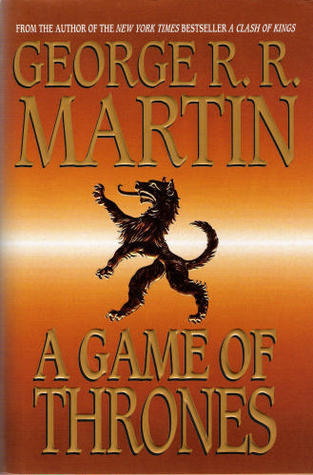
A Game of Thrones (A Song of Ice and Fire, #1)A Game of Thrones, by George R.R. Martin

Or as I call it, A Game of Endless Unlikable Characters. 

My husband DEVOURS these books. When he's immersed in one of them, he doesn't pay attention to much else. He loves them.

Then my 17-year-old son, who used to be such a great reader but in recent years has been deterred by electronics, also read the whole book and is now watching the show.

Plus one of my close friends, who doesn't usually go for fantasy, became obsessed with the show and the books, and she told me that I should give them a try.

So I gave Book 1 a try, and I will not be reading any more of the series. Remember, I finished Book 1 of the Lord of the Rings series and gave up during The Two Towers. Fantasy is not my thing, unless it's something fun like Harry Potter. I can take the violence, and I have read many dystopian sci-fi novels. It's just that this didn't hold my interest.

I should have known better when in the beginning, every single chapter was told from the perspective of a different character. I have a 50-page rule (ala Nancy Pearl). I was about to give up, but then on Page 49, we returned to a character that I had seen before. So I plowed on, thinking I might become more engaged.

When I took a break at around Page 625 to read The Chaperone and enjoyed it much more, I should have known better. 

I also should have considered that my husband never thought I would like these books. 

But I was determined to finish the book, much like I felt that I needed to read Twilight. It's such a part of our popular culture, and I wanted to know why everyone seems besotted with it.

So here are the 10 reasons I wasn't crazy about A Game of Thrones:

1. Far too many characters!
I know Martin provides lists at the end of the book, but honestly, why did there have to be so many? I lost track. Many of the characters are mentioned in passing only once or twice. Why include them at all?

2. Lack of character development
Very few of the multitude of characters are fleshed out fully. Even the primary characters...we get very little back story on how they became who they are, with only a few exceptions.

3. Lack of sympathetic characters
The only person I cared about in this book was Arya Stark. That's it. I didn't care what happened to anyone else. Daenerys was interesting, but she was brutal too. Ned was better than most of them, but even he was not loyal to his wife and had a dark past. Nearly everyone in this book lacks morals, compassion, or kindness. These people are unlikable!

4. Rape and brutal treatment of women
I had heard that Game of Thrones had lots of sex, but I didn't expect the huge amount of rape and horrific treatment of women...constant child bride rape, incest, gang rape, and forced prostitution. Is this typical of fantasy? No thank you. I'd heard that this series has more strong female characters than other fantasy books, but even those strong female characters are often powerless in such a patriarchal, misogynist culture.

5. Too much detail
Martin goes way into detail about political posturing, history of various families, and geography, while sacrificing real, valuable information. And then there's the endless, repeated titles of royalty, such as "King Joffrey, the First of His Name, Lord of the Seven Kingdoms, and Protector of the Realm," blah, blah, blah. 

6. Way too long
I am not scared of long books. In fact, I loved Vikram Seth's 1,500-page long A Suitable Boy. But you've got to keep me interested to make me feel like the length is worth it. This book could have used a good editor. (See #1 and 5.)

7. Endless plots
From what I understand about this series, each book does not end...it just goes on and on into more books. I need closure. 

8. Lack of geographic perspective
I needed a map, like Tolkien provided. I am a visual person. Where in the heck is "The Neck"? How does the wall divide the kingdom? So much of this book and series is about place and kingdoms. I didn't know where the heck anything was, except sometimes "north" or "south."

9. Does not compel me to read any more
I'm not interested in seeing where this series continues. 

10. Very sad outlook on humanity
J.R.R. Tolkien wrote wonderful villains and complicated characters and had redemption in his books...the friendship in the fellowship of the ring, the rip-roaring fun in the Shire, the wisdom of Gandalf, the great adventure, the beautiful Elfen lands...so many more things to like about that series, even though those books were not my cup of tea either. As one reviewer wrote, "I have bums and alcoholic friends that blaze like Gandalf the White compared to most of Martin's characters." That reviewer went on to say "It is a story mired in filth and obscenity and shines the light on the worst conditions of human experience and offers them up as plot lines, dialogue and personal, social and political interactions."

As I mentioned above, I've read my share of dystopian literature (The Hunger Games series, The Road, A Handmaid's Tale, etc.), but even those types of books have some redemption in them, usually in the relationships between the characters. If I'm going to read a dark, dark book, I need to get some satisfaction out of it. 

My apologies to the Game of Thrones lovers!

Saturday, October 16, 2010

Tattoos on the Heart: The Power of Boundless Compassion

I first heard of this book when our pastor read a memorable story during her sermon--of taking two homeboys out to a restaurant for the first time in their lives. Gregory Boyle is a Jesuit priest in Los Angeles and the founder and executive director of Homeboy Industries--the largest gang intervention program in the country. The organization's motto is "Nothing stops a bullet like a job." Fr. Boyle has been working amongst gang-afflicted kids and young adults for 24 years.

This book is a collection of his stories--full of gut-wrenching pain, beauty, loss, and grace.
He tells stories about homies who are shocked to their core that someone actually believes in them or takes the time for them. Kids who have never felt any worth finally get real jobs and make lives for themselves. Sworn enemies work side by side and become friends. He writes about the women of his church, who love these kids through their flaws and felonies.

The stories are interspersed with lovely quotes that help emphasize his stories and message, such as this one:
"It's when we face for a moment the worst our kind can do, and shudder to know the taint in our own selves, that awe cracks the mind's shell and enters the heart." --Denise Levertov  
Some of these kids have been abandoned or abused by their parents and have never experienced the Japanese concept of "amae," living in a deep sense of being cherished.

Fr. Boyle and his colleagues attempt to do this for the homies. He notes, "The great encounter with the 'father wound' is every homeboy's homework." He also writes about moms who take seven separate buses to see their sons, every Sunday, and compares this dedication to the expansive heart of God.

He writes about hardened, violent, criminal gangsters who turn into emotional little boys when they are deeply loved unconditionally.

The title, "Tattoos on the Heart," comes from this story, which gives you a brief glimpse of the deep, enduring effects Fr. Boyle (or "G," as they call him) has on the young people he helps:
"Once, after dealing with a particularly exasperating homie named Sharkey, I switch my strategy and decide to catch him in the act of doing the right thing. I can see I have been too harsh and exacting with him, and he is, after all, trying the best he can. I tell him how heroic he is and how the courage he now exhibits in transforming his life far surpasses the hollow 'bravery' of his barrio past. I tell him that he is a giant among men. I mean it. Sharkey seems to be thrown off balance by all this and silently stares at me. Then he says, 'Damn, G...I'm gonna tattoo that on my heart.'"
In his 24 years of working with homeboys and homegirls, Boyle has buried 168+ of them. Can you imagine?

This book brought tears to my eyes multiple times. Boyle lives out his belief that it is our responsibility as human beings to make sure "the voices on the margins get heard and the circle of compassion widens." I feel honored to have witnessed a tiny glimpse of this compassion through these stories.

Monday, October 11, 2010

Mockingjay: Real, or not real?

My rating: 4 of 5 stars

This morning I finished Book #3 of the Hunger Games trilogy, Mockingjay. Suzanne Collins has crafted an amazing allegorical story, full of vivid imagery and memorable characters. As I mentioned in my review of Catching Fire, the world in these books is not as far from our modern-day world as we might think. We are the privileged ones in the Capitol, and the developing world produces much of our goods and services. Their compensation is unfair and their conditions are often untenable. We are aware of this yet we do little about it.

Some readers found Mockingjay to be a highly satisfying end to the series, while others were sorely disappointed. I found myself feeling greatly relieved to be finished with the series, as brilliant as it is. (This is why I gave it four stars rather than five--it's brilliant stuff but I reserve five stars for books that make me feel good.) I feel that way each time I read a dystopian book--with the exception of the Harry Potter series, they seem to be the types of fantasy novels I read (The Handmaid's Tale,The Left Hand of Darkness, The Road, etc.). I felt tainted and disturbed after reading each one of these books. They stick with me for days afterward. That's the point.

Many of the disappointed readers note that Katniss is not her feisty, fiery self in this final book. She seems to be broken and lacking in choices throughout the book. She's often on the edge of the action instead of in the middle of it. That's true...but I think her lack of choice--and her exhaustion--is exactly the point Collins is trying to make. She's still a child, and she's seen and experienced more horror and tragedy than any person should have to bear.

SPOILER ALERT

***************************************************************************


Some reviewers have commented that Prim's and Finnick's deaths were too slapdash, and it's true--they were. However, that reflects the nature of war. Soldiers cannot take much time to mourn their loved ones lest they let their guard down and make themselves vulnerable.

President Coin's complicity in the violence and betrayal disillusioned me. I wanted to believe that the rebels were fighting against the evil, not seeking to continue it. And Plutarch chose to join the rebel cause for what, if not to fight for a higher, more noble cause? In the end, he is no better than those in the Capitol because he joins in Coin's plot.
When Katniss votes to let the Hunger Games continue, I was so disappointed in her. Then after she tricks everyone and kills Coin instead of Snow, it left me wondering whether this was a split-second decision or a calculated move. Collins illustrates the human tendency to perpetuate the violence a person suffers, just as abuse victims do.

Gale's choices did not surprise me in the end, although the love triangle was resolved passively for Katniss instead of her taking a stand and making a choice for Gale or Peeta. This is why some readers have said that Katniss didn't make active choices in this final book. Things happen to her (with a few exceptions) instead of her happening to things.

After all that death and destruction at the end, it was somewhat surprising to have a relatively "happy" ending, although Katniss will always be haunted by the Hunger Games. I'm a happy ending sort of person, so I liked the way it ended.


View all my reviews

Friday, September 17, 2010

The Hour I First Believed: A novel about Columbine

The Hour I First BelievedThe Hour I First Believed by Wally Lamb

My rating: 4 of 5 stars

Do not read this if you cannot stomach sad stories. This was a classic tragedy in many ways, even with supplemental myths and metaphors. Wally Lamb is a skillful writer, and he wove together the story of complicated protagonist Caelum, his third wife Maureen (who survives the Columbine tragedy and is forever marked by it), the women's prison on the family's property, refugees from New Orleans, lost teenage and adult souls, and Caelum's ancestors.

In Lamb's afterword, he quotes James Baldwin: "People who treat other people as less than human must not be surprised when the bread they have cast on the waters comes back to them, poisoned."

It's a book about the devastating nature of alcoholism, cruelty, violence, and war. And how in the midst of it all, humans somehow find each other and love each other.


View all my reviews